








ochres and coloured earths
Main qualities
- covering and colouring capacity: can be mixed in all liquids, no reaction with limes, silicates and cements,
- not altered by ultraviolet rays,
- non-toxic,
- relatively low cost.
What are coloured earths used for?
- paint, colourwash: 80%
- Colouring concretes: 9%
- Colouring cardboard, rubber, wax: 8%
- Colouring snow clearance salt, agricultural use, animal feed: 3%
What were they used for?
- Food dye: pork sausage skins, chocolate during the war when there was a shortage of cocoa, snuff, Gitane Maïs cigarette paper, cheese crusts, and the like.
- As a medicine: desiccative and astringent properties (ferruginous substances), for stomach ache in the Middle Ages.
- To clean silverware, to polish metals, mirrors, to revive the colour of terra cotta flagstones.
- To protect wood from water (shutters, hulls of boats and so on).
- Manufacturing of wallpapers and linoleums.
- To colour rubber.
- Cosmetics.
Extraction
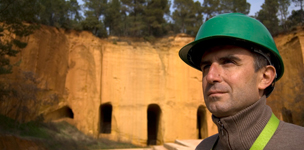
There are two types of sites: in Vaucluse, for example, you can find open air quarries consisting of an ochreous sand cliff which contains 10% to 15 % of pure ochre, while in Burgundy the mines are about thirty metres deep and the ore is rather pure. The seam is limited by a yellow bed of clay that should not be mistaken for ochre.
Separation
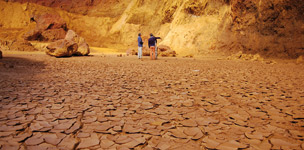
First of all the ore must go through the washing process, which is done by malaxation under running water. Sands and the impurities settle in V shape decantation drains, while the fine colouring particles, finer and lighter, move towards mud tanks.
Evaporation and drying
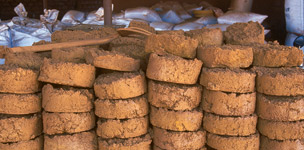
After drainage, the earth (known as washed earth) is left in the basins to be dried. It is then taken and cut into loaves (or brioches).
Machining and conditioning
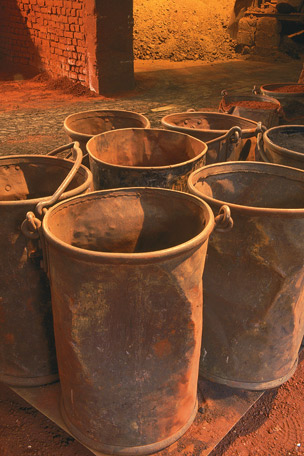
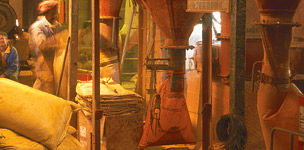
It is fired to obtain various colours (the red is obtained by calcination of the yellow ochre), then crushed, sifted and put into bags (barrels in old times).
Samples
1
2
3
4
5
6
7
8
9
10
11
12
13
14
15
16
17
18
19
20
21
22
23
24
25
- natural sienna ardennes
- natural sienna italy
- calcined sienna ardennes
- calcined sienna italy
- yellow ochre vaucluse
- yellow ochre nièvre
- icles ochre
- havane ocre
- dunkel ocre
- red ochre vaucluse
- red ochre nièvre
- hematite nièvre
- natural umber Italy cpr
- calcined umber Italy aek
- calcined umber Italy cccn
- natural umber Cyprus hg.or
- natural umber Cyprus fl.or
- natural umber Cyprus b.c.or
- calcined umber Cyprus b.or
- yellow earth
- red earth Sardinia
- Rome black
- red Pozzuoli
- red ercolano
- venitian red